EN 71 is a family of European toy-safety standards and test methods, not a single certificate. For magnetic tiles, an importer should match the supplier’s test report to the exact model, materials, age grading, accessories and packaging version, then check that the cited standard editions and conformity route fit the destination market and placing-on-the-market date. A report for a similar set is not enough.
What EN 71 means—and what it does not mean
EN 71 refers to a series of European standards used to assess aspects of toy safety. A laboratory report can show which tests were performed, which standard editions were cited and which sample was tested. It is not a blanket certificate that automatically covers every magnetic tile set from a supplier.
The European Commission explains that the EU Toy Safety Directive sets essential safety requirements, while technical detail is developed through European standardisation. The Commission also provides the official references for harmonised standards. Those references and the legal route for a specific product should be checked at the time of market entry.
EN 71 evidence also does not replace the full conformity process. CE marking, the technical file, declarations and the responsibilities of the relevant economic operators still need to be handled under the rules that apply to the product and destination.
Match the report to the actual magnetic tile set
Before accepting a file, compare the report with the product that will be packed and sold. Use the following fields on the same request:
| Identity field | What to compare | Why it matters |
|---|---|---|
| Model and reference | Supplier SKU, model name, revision and report sample reference | Similar names do not prove the same construction. |
| Contents | Piece mix, magnets, accessories and materials | A changed component can change the test scope. |
| Age grading | Age stated on the product, packaging and report | Warnings and assessment depend on the intended age group. |
| Packaging version | Reusable tin, color box, display box or another confirmed package | Labels, instructions and the packed configuration must match the marketed version. |
| Market and date | Destination country, importer role and intended placing-on-market date | The applicable legal route and document set are market- and time-dependent. |
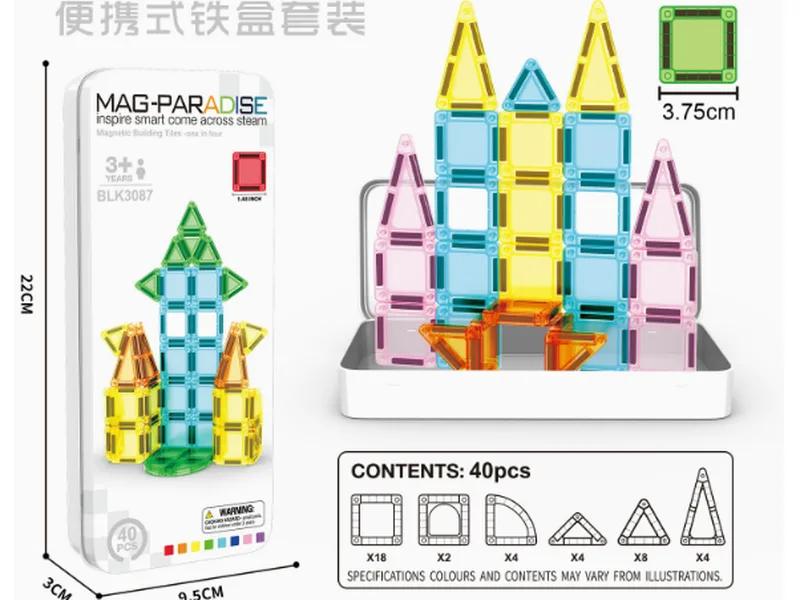
Keep tin-box and color-box versions as separate records, even when the play pieces look identical. Do not transfer a report or packaging statement from a reusable tin version to a color-box version without written scope confirmation.
Check the standard editions and official references
Ask the supplier or laboratory to identify the EN 71 parts tested, the edition or amendment cited, the test date and the laboratory. Then compare the cited references with the European Commission’s current Toy Safety information and its official harmonised-standard references. A report that simply says “EN 71 approved” leaves too much unresolved.
The Commission page currently describes the transition to the new EU Toy Safety Regulation. It states that Regulation (EU) 2025/2509 entered into force on 1 January 2026 and starts applying on 1 August 2030 after a four-and-a-half-year transition period. Do not turn those dates into a legal shortcut: confirm which requirements and conformity route apply to your product’s actual placing-on-the-market date.
Questions to put in the importer file
- What exact model, revision and packaging version does the report cover?
- Which EN 71 parts and standard editions are named, and what sample was tested?
- Do the piece mix, magnets, materials, accessories, age grading and warnings match the production specification?
- What laboratory issued the report, on what date, and does the report identify the tested configuration?
- Which technical file, declaration and CE-marking steps remain with the manufacturer, importer or other economic operator?
- Has a product, magnet, material, artwork, instruction or package change triggered a new review?
Save the supplier’s answer with the report instead of relying on a filename or a product photo. If a field is missing, mark it “to be confirmed”; do not fill it with a similar SKU’s data.
Keep EN 71 separate from CPC, CE and CPSC terms
These terms describe different things. EN 71 is a standards and testing reference. CE is a European conformity marking supported by the applicable technical documentation. CPC is a US Children’s Product Certificate, while CPSC is the US regulator and its applicable requirements. MagBlockPro’s general CPC, CE and UK documentation guide compares the terms; this page stays focused on the EN 71 report-matching decision.
EN 71, CPC, CPSC-related testing and CE documentation may be available for applicable models; exact coverage must be verified by model and destination market. No document should be treated as universal legal clearance.
What this means when requesting a quote
For a compliance-focused enquiry, send the product or model reference, destination market, expected quantity, packaging version and the files you want checked. For tin-box products, use the confirmed Travel Sets range; for color-box or other packaging, start with the general product catalogue. If you are also planning a one-carton trial, confirm the carton fields in the magnetic tiles MOQ guide. Product identity and packaging version should be confirmed before a supplier maps any report to your order.
Email: [email protected] · WhatsApp: +86 158 1454 8866
Frequently asked questions
Is EN 71 a certificate?
No. It is a family of European toy-safety standards and test methods. A laboratory report may record testing against relevant parts; the report is not a universal certificate.
Does one EN 71 report cover every magnetic tile set?
Do not assume that. Confirm the exact model, materials, magnetic components, piece mix, age grading and packaging version covered by the report.
Do EN 71 reports replace CE responsibilities?
No. EN 71 test evidence supports a conformity assessment. CE marking and supporting technical documentation and declarations remain part of the applicable EU market process.
Which EU toy rules apply during the transition?
The European Commission states that Regulation (EU) 2025/2509 entered into force on 1 January 2026 and starts applying on 1 August 2030 after a transition period. Confirm the legal route for the product’s placing-on-the-market date.